



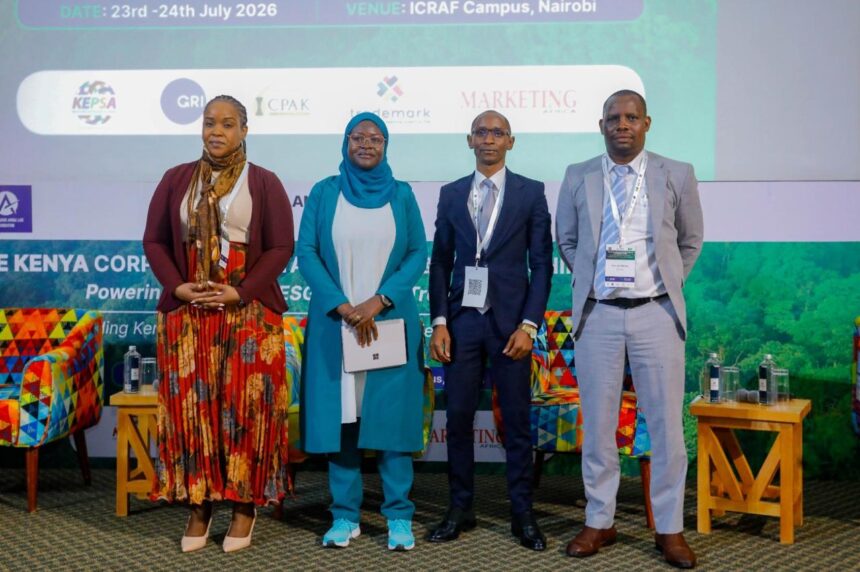
The Kenya Tree Economy Initiative ( KETEI) wants companies to pool capital, finance restoration and receive verifiable sustainability data in return. It is an ambitious attempt to move corporate tree planting beyond goodwill, but several difficult questions remain.
For years, corporate tree planting has followed a familiar script: branded T-shirts, rows of newly planted seedlings, speeches about environmental responsibility and a photograph recording the occasion. But what really happens after the cameras leave?
How many trees survive? Were they planted in the right ecosystem? Who maintains them? Did surrounding communities benefit? And can the company prove the environmental impact reported in its sustainability disclosures?
These questions dominated the Kenya Corporate Sustainability and Leadership Forum held at the ICRAF Campus in Nairobi. At the centre of the conversation was the Kenya Tree Economy Initiative (KETEI) which is seeking to replace isolated corporate planting exercises with a shared, measurable and potentially revenue-generating restoration model.

Planting trees is only the beginning
Kenya has committed to growing 15 billion trees by 2032, restoring 10.6 million hectares of degraded land and increasing national tree cover to 30 per cent. It is an ambitious target covering forests, farms, wetlands, rangelands, urban areas and marine ecosystems. Achieving it will require the participation of government, businesses, communities and individual citizens.
However, the national conversation often focuses on how many seedlings go into the ground rather than what happens to them afterwards.
Figures presented at the forum indicated that 738 million trees had been verified through the government’s JazaMiti platform. That number does not necessarily represent every tree planted in the country, since not all planting is recorded on the platform. At the same time, registering a seedling does not confirm that it survived.
This reveals the central challenge: planting numbers alone cannot tell us whether a landscape is recovering.
A successful restoration project should be able to show whether trees survived, whether biodiversity improved, whether soil and water systems were protected and whether local people gained lasting economic value.
Why companies need better evidence
Sustainability reporting standards require companies to explain how climate-related risks and opportunities affect their strategy, finances and long-term performance. It is no longer enough to say that a company planted thousands of trees.
Businesses must increasingly show where the trees were planted, how many survived, what environmental change occurred and how the results were verified.
Tools such as satellite imagery, geographic information systems and remote sensing can help track changes in vegetation and land cover. Scientific monitoring can also measure tree survival, carbon storage and biodiversity.
This could make corporate environmental claims harder to exaggerate. It could also help the public distinguish between genuine restoration and greenwashing.
However, the data must be independently credible. If several businesses finance the same project, clear rules will be needed to prevent them from claiming the same tree, hectare or carbon benefit in their individual reports.
Measurement must also go beyond quantity. A plantation containing thousands of trees is not automatically equivalent to a restored indigenous forest, healthy wetland or functioning biodiversity corridor.
The right species must be planted in the right place and maintained for long enough to produce meaningful results
Who owns the value?
Turning trees into economic assets also raises difficult questions.
If restoration takes place on public land, who owns the trees and their products? If a project generates carbon credits, who receives the income? Do the companies providing capital receive financial returns, environmental credits or simply verified data for their sustainability reports?
Most importantly, what do surrounding communities gain?
A tree economy may sound like a technical corporate concept, but its consequences extend beyond company boardrooms.
Healthy landscapes affect the water people drink, the food farmers produce, the temperatures experienced in towns, the availability of rural jobs and the country’s ability to withstand droughts and floods.
The public therefore has a stake in asking better questions whenever a company announces a tree-planting campaign:
- Where were the trees planted?
- Were the species suitable for that ecosystem?
- Who will maintain them?
- How many are still alive?
- Who independently verified the results?
- How are local communities benefiting?
Kenya does not lack tree-planting promises, corporate goodwill or ambitious targets. What it lacks is a consistently transparent connection between money spent, trees surviving, landscapes recovering and communities benefiting.
The success of a tree economy will not be measured by photographs, launch ceremonies or the number of seedlings placed in the ground. It will be measured years later in trees that remain standing, ecosystems that are healthier, environmental data that can withstand scrutiny and communities that receive a fair share of the value created.